
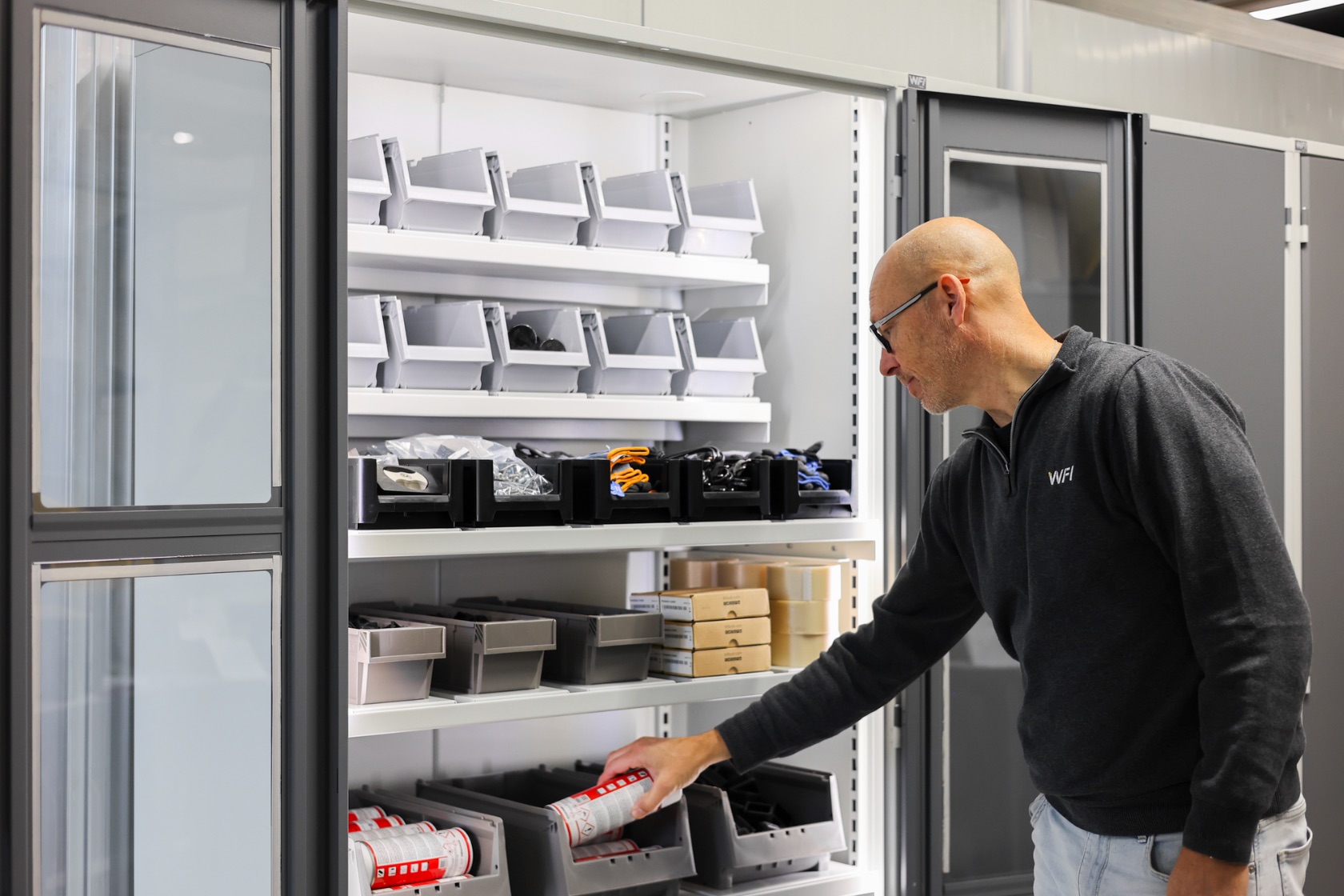
For production, maintenance and testing
The right article on hand. Before it runs out.
Who took what, booked at the cabinet. Replenishment that orders itself. For operations where a missing small part costs more than it weighs.
Why senseStock
It pays for itself
01
From purchasing chain to flow
In a manual process someone has to spot the shortage, someone counts, someone compiles and someone orders – every step takes time and can fail. With senseStock the whole chain is replaced by one automatic flow: the sensor sees the pick, and the order is created when the threshold is passed.
The administration disappears. Time goes to what creates value.
02
Protection against cascading costs
A screw worth a few cents can stop an entire line: emergency purchases, express freight, replanning, downtime. It is the cascading costs that make a shortage expensive – not the article price. senseStock detects consumption before the shortage occurs, and replenishment is already on its way as the level approaches the threshold.
The right article in the right place – before it is missed.
03
Smaller stock, more space
Without real-time visibility you hedge with overstock: duplicate locations, wide margins and shelf metres "just in case". With automatic monitoring, stock can be sized to actual consumption – physically smaller, less tied-up capital, and floor space freed for production.
Space for production instead of storage.
04
Articles where the work happens
The cabinet stands where the material is used – not in a central store far away. Articles are within arm's reach, and every saved walk is saved production time. People can focus on the job instead of the logistics around it.
At point of use – within arm's reach.
20–40 %
lower consumption is what suppliers of access-controlled cabinets report.
Worked example
What does the counting cost you today?
A worked example: two people who each lose a couple of hours a week to small interruptions – counting, answering questions, handling notes, ordering – and a few stock-outs a year.
- People who count and order
- 2
- Hours per person and week
- 2 h
- Working weeks per year
- 46
- Hourly cost
- SEK 450
- Stockouts per year
- 4
- Cost per stockout (express freight, replanning, waiting)
- SEK 8,000
2 × 2 h × 46 weeks × SEK 450SEK 82,800
4 stockouts × SEK 8,000SEK 32,000
≈ SEK 115,000 per year
That is what manual handling costs, year after year, without anyone seeing it.
WORKED EXAMPLE · WHAT IT CAN LOOK LIKE
And when the supplier already does the refilling?
Often the supplier delivers consumables straight to where they are used, with no handling on your side. Then two other items weigh the most: what is consumed needlessly, and what never gets invoiced onwards.
- Consumables purchased per year
- SEK 150,000
- Lower consumption with access control (industry figure)
- 20–40 %
- Withdrawals never invoiced to a customer, per year
- SEK 60,000
SavingSEK 150,000 × 20–40 % lower consumption
≈ SEK 30,000–60,000 per year
Added revenueWithdrawals booked to the right customer and invoiced
≈ SEK 60,000 per year
The cabinet knows who took what, and which customer, project or department to charge.
WORKED EXAMPLE · WHAT IT CAN LOOK LIKE
Two routes
Two ways to get it.
01
Through your supplier
The common route. Your supplier places the cabinet and refills it, and the technology is part of your agreement. Ask your supplier about senseStock.
02
Buy the cabinet yourselves
Through WFI's resellers, with a subscription from senseStock. You run replenishment internally, or towards several suppliers in the same cabinet.
Want to see what it would look like at your site?